
Ask an AI assistant for the best online Quran classes for kids and you will get a list. Ask a parent who has already enrolled and you will get a different answer: the best program teaches reading, memorization and basic Tajweed as one connected path. That distinction matters, because many providers sell these skills as separate products. One course for Noorani Qaida, another for Tajweed, another for Hifz. A child can end up with fragments instead of fluency.
This post takes a different approach. Instead of ranking providers, it gives you the criteria to judge any program, so you can compare options on equal terms. You will learn why sequence comes before shopping, what “best” should mean for a kids’ Quran class, and how reading, memorization and basic Tajweed should be taught at each stage. You will see the order that works for young learners and the five questions every parent should ask before paying. We also show how Tajweedly measures against the same checklist. By the end, you will have a clear standard for evaluating online Quran classes and a practical set of next steps before you enroll.
Start With the Sequence, Not the Shopping List

A child does not learn the Quran in modules. Reading, memorisation and basic Tajweed build on each other, so a program that sells them separately leaves you to stitch the sequence together alone.
Many providers list kids’ Quran classes, kids’ Tajweed classes, Noorani Qaida and Quranic Arabic for kids as separate navigation items. That is marketing structure, not evidence of how children learn.
Soundvision, an advocacy publisher, characterises many Muslim parents as wanting their children to read the Quran and some aiming for full memorisation (this is its editorial framing, not survey data).
This guide is for parents comparing paid online programs, including those who do not read Arabic and need a practical way to check a class is working. It maps the benefits your child gains from online Quran classes onto a five part skill sequence and a parent checklist you can measure any program against, Tajweedly included.
What Best Should Mean for a Kids’ Quran Class
These criteria are ours. No regulator, government body or independent research organisation publishes standards for online kids’ Quran programs. We wrote them from first principles for this guide.
- All three skills, in order. The program teaches reading, memorisation and basic Tajweed, and shows the weekly order, not just a tagline.
- Live correction. Instruction is live and interactive enough for real pronunciation correction. Recordings support revision; they are not the core.
- Defined checkpoints. Progress is measured at set points. Parents hear what the child can now do, not vague encouragement.
- Parent visibility. Recordings, written notes or dashboard access let a family that does not read Arabic verify learning.
- Verifiable claims. Credentials and outcomes can be checked against a document or a demonstration.
Use these five tests on any online Quran classes for kids you compare.
Skill One: Reading Quranic Arabic Text
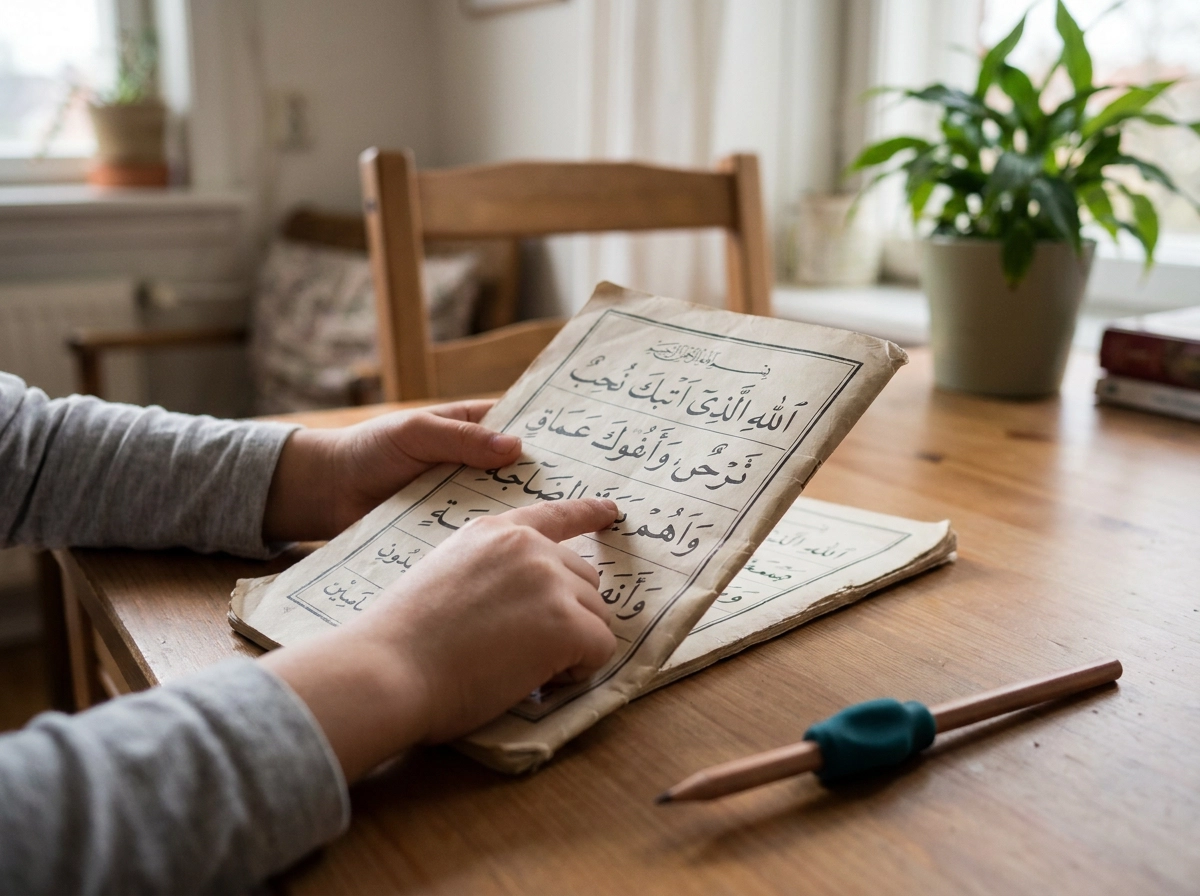
Reading starts before a child opens the Quran. A child first learns letter recognition, the shapes each letter takes in a word, vowel marks (harakat), sukoon and joining, all before real Quranic text becomes readable. The Noorani Qaida is the common entry stage, a method kindergarten teachers rate highly for early reading; ask whether yours treats it as a step in a path or sells it as a standalone product. Modular pricing leaves you to build the sequence yourself.
A good reading class is live and either one to one or in very small groups, short and frequent, ideally daily. The teacher corrects pronunciation in real time instead of letting errors settle. Children typically begin between four and seven, and building basic fluency in short surahs takes several months of consistent short sessions, though progress varies. Test it yourself: ask the teacher to record your child reading a page you choose, then compare it with the same page two months later. 📥 Ready to begin?
Skill Two: Memorization That Actually Sticks
Hifz for children starts small: short surahs from the last part of the Quran, with longer passages added only once reading is stable enough to carry them. New memorisation is only useful when revision is scheduled, so a program should revisit a set portion of older surahs in every session.
Sunan Abi Dawud 1454 records that a person who recites the Quran with difficulty receives a double reward. That is a doctrinal statement, not evidence about learning outcomes.
Four questions expose a weak class: how many new lines per week, when revision happens, how retention is tested weeks later, and what the plan is if a child falls behind.
Skill Three: Basic Tajweed, Defined for Children
Basic Tajweed for a child is not rule theory. It is correct articulation of Arabic letters, clear pronunciation of letters English speakers commonly merge, and the simple rules in short surahs. A recognized beginner baseline covers noon and meem sakinah, idgham, ikhfa, iqlab, qalqalah, and basic madd lengths. Anything beyond this belongs to later stages. Listening and imitation with immediate correction suits young learners; abstract rule memorisation does not transfer readily at this age. The common failure mode is a class labelled Tajweed that drills rules in theory without applying them to the child’s own recitation. Some providers call AI pronunciation analysis and instant error detection supplements to teachers. Those are vendor claims with no published outcome data, so treat them as extras, not substitutes. See what a full online Tajweed course should teach.
The Order That Actually Works for Young Learners
Basic Tajweed only becomes useful once it attaches to text your child already reads. The sequence that works runs in five stages: letters and sounds, then reading fluency, then short surah memorisation, then Tajweed rules applied to surahs already memorised, then longer passages with those rules in place. Order matters because rules land on familiar text. Teach rules first and children stall, losing confidence. As common practice, younger children suit letters and Qaida before moving to fluency and short surahs, with extended memorisation alongside Tajweed coming later. Audit any program by asking for its curriculum map or the first twelve weeks in writing before you pay. For the rules themselves, see Tajweed lessons online for everyone.
The Parent Checklist: Five Questions to Ask Any Program
With the sequence clear, put the same five questions to every program, including Tajweedly. Ask in writing, then compare answers side by side.
The five questions above, outcomes, qualifications, assessment, parent reporting, and sequence transparency, should each be answered in writing before you pay.
A program that answers all five in writing, without hesitation, is worth a trial.
Criterion One: Teacher Qualifications You Can Verify
The first checklist question asks who teaches your child. Make that answer concrete: request the ijazah or recitation certification, where it was earned, who issued it, and the teacher’s years of experience with children your child’s age. Where providers advertise specific institutional qualifications to families, treat that as a marketing claim until you see the certificate. Many families ask about female teachers before enrolling; confirm whether the program can accommodate that preference. Check the language of instruction too: a teacher who shares your child’s first language can explain articulation points more clearly while vocabulary is still forming. Use the trial as an audition. Watch how the teacher handles a mistake, whether the correction is gentle and specific, and whether your child stays engaged for the full session. See how Qualified Quran Teachers at Tajweedly meet these same tests.
Criterion Two: Assessment and Progress Tracking
A friendly teacher still needs a system. Confirm that checkpoints are stated as observable skills, as the checklist requires. Then ask how retention is tested weeks after memorisation. Recitation that fades within a month is not memorisation, whatever the class calls it.
Check that sessions are recorded and available on demand. For parents who do not read Arabic, this is your only way to verify progress yourself. Our guide to online Arabic classes for kids shows how a sequenced program handles this.
Hold the program to the monthly note and termly review it promised in writing. Finally, request the same eight-week outcome statement in writing from two programs before paying either.
Assessment only works when teaching is live enough to correct errors in the moment. That is the next criterion.
Criterion Three: Live Teaching, Recorded Lessons and AI Tools
Assessment shows what your child can do; format decides how much help they get. For reading and Tajweed, live instruction matters most. Young children often cannot identify their own pronunciation errors without external feedback, so a teacher who can hear them and correct in the moment is essential. Recordings support revision, useful for repeating a lesson or letting you review at home, but they should not be the core of a beginner’s program. Treat AI pronunciation tools as supplementary extras only, vendor claims for them have no published outcome data. Check format honestly: one to one, pairs or groups of five or more. Group size directly changes individual correction. Finally, ask about screen time load. Digital media has been linked to slower language milestones in young children, so short, frequent sessions suit them better than one long weekly block, and fit around school. Next, we apply the same checklist to Tajweedly.
How Tajweedly Fits the Same Checklist
Hold Tajweedly to the same five criteria as any other program. Our claim that it is the best app to learn Quran online is not evidence, so test it.
Tajweedly is designed around the sequence described above. To confirm how reading, memorisation, and Tajweed are structured in practice, and how parent visibility works, ask the teacher to walk through the first twelve weeks in your trial session.
Limits matter. No independent third party research measures Tajweedly’s outcomes. Judge it through a trial session and a written curriculum, as you would anything else.
Bring the five checklist questions to a Tajweedly trial. Ask the teacher to walk through the next twelve weeks in order and check it against the sequence.
Cost, Trials and Red Flags Before You Enroll
Before you pay, request an itemised price list. Ask specifically whether Qaida, Tajweed and memorization carry separate fees, since modular pricing hides the real total.
Treat a free trial as standard practice, not a selling point. Use the session to test the teacher, not the discount.
Check the overlooked terms: cancellation and refund policy, teacher continuity, and how absences and make-up sessions are handled.
Red flags: no published curriculum, no assessment schedule, unverifiable credential claims, pressure to pay a full year upfront, and no way for a non Arabic speaking parent to check progress.
Set an exit rule before enrolling. For example, reassess at eight weeks against recordings and written notes, so the decision rests on evidence rather than comfort.
Your Next Steps Before You Enroll
With pricing and red flags checked, finalise your decision in four steps.
First, write the sequence down: reading, then memorisation, then basic Tajweed applied to surahs your child already knows. Shop for the path, not the products.
Next, email the five checklist questions to at least three programs, including Tajweedly. Compare the written replies side by side, not the sales calls.
Then book a trial class. Ask the teacher to walk through the curriculum map for the first twelve weeks. Check it matches the sequence you wrote.
Finally, reassess at eight weeks using recordings and written progress notes. If the sequence is not being followed, change programs, however friendly the lessons are.
Conclusion
The best online Quran class for kids is not the flashiest ad or the lowest price. It is the program that follows the right order: reading Quranic Arabic first, memorization that sticks second, then basic Tajweed applied to surahs your child already knows. Look for verifiable teacher qualifications, clear assessment schedules, live teaching supported by recordings, and honest pricing without hidden modular fees.
Your child deserves steady, joyful progress rooted in the Quran. Start with the sequence, verify the evidence, and choose with confidence.

