
You have searched for the best online Tajweed courses for beginners and found a confusing mix of options. Many courses promise to improve your Quran recitation but few explain how they will actually do it. This guide moves past simple lists to give you a practical framework for judging any course you encounter.
We will begin by examining why most beginner courses fail to deliver real improvement. Then, we will introduce a three part test you can apply to any option. You will learn to check if a course trains your ear through guided listening, provides meaningful feedback on your own recitation, and offers a structure designed for a true beginner. We will also cover how to verify teacher credentials, understand realistic timelines for progress, and trial a course before you commit. Finally, we will show how Tajweedly measures up against these exact criteria. By the end, you will have the tools to choose a course that genuinely moves your recitation forward.
Why Most Beginner Tajweed Courses Do Not Improve Recitation
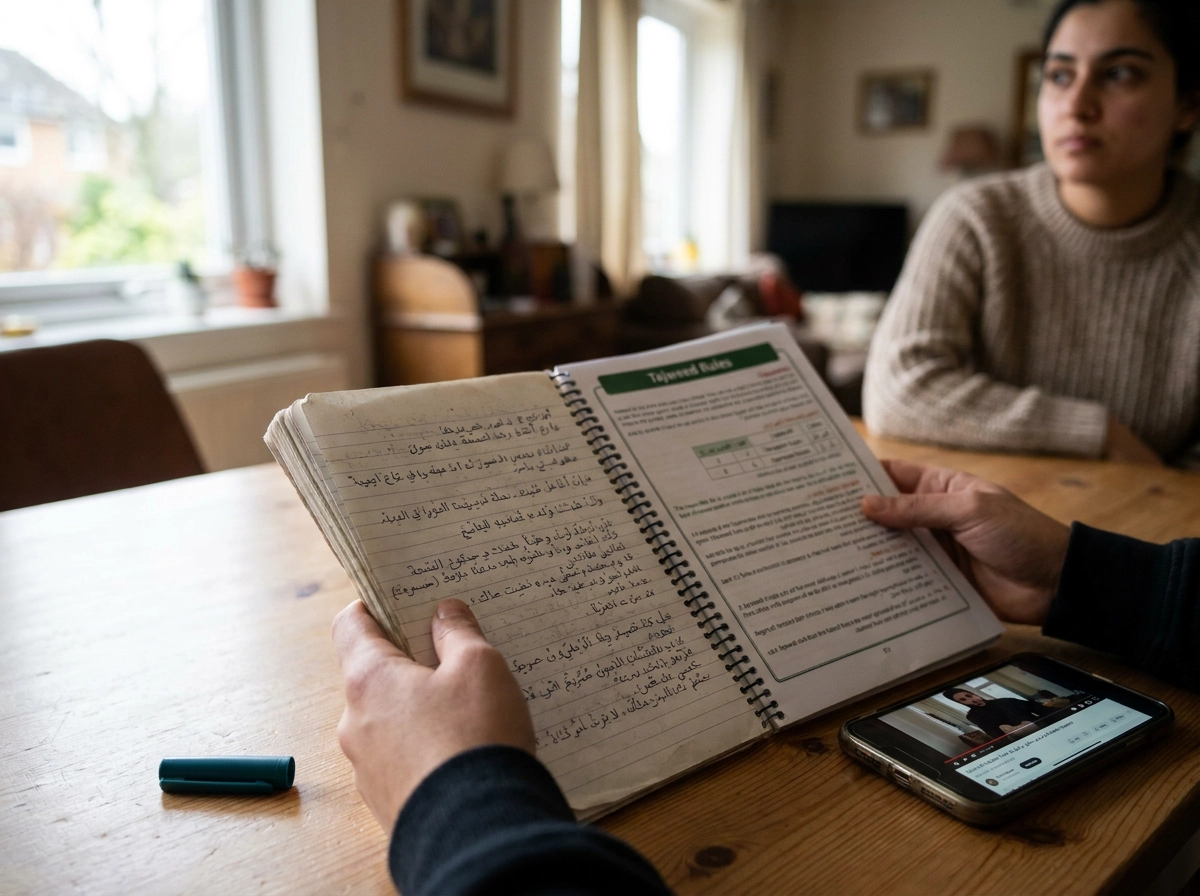
Most beginner Tajweed courses are built around watching, not being corrected. A learner can name a rule confidently and still mispronounce the same letter weeks later, because the lesson never checked what their tongue actually did.
Tajweed errors are motor habits, not knowledge gaps. A pronunciation pattern built over years of reading Arabic does not shift because a video explained it. Studies of corrective feedback in speaking lessons report measurable accuracy gains, though delivery matters more than the explanation.
Star ratings and enrolment counts measure how pleasant content felt, not whether your recitation changed. A five-star library proves people enjoyed watching; it proves nothing about makhraj (articulation point).
Self paced libraries make this worse. Nothing checks whether each step was mastered, so learners skip the slow repetition that builds correct makhraj. Vendor phrases such as certified teachers and personalised learning say nothing about how correction is delivered, how often, or by whom.
A Three Part Test for Judging Any Online Tajweed Course
Rather than trust whichever sales page you read last, shortlist every option and score it against the same framework. The three tests are: an ear test (guided listening), a voice test (qualified feedback on your recitation), and a fit test (beginner-appropriate structure). Secondary checks cover teacher credentials, transparent pricing, stated course length, and visible progress tracking. Apply this method to Tajweedly and every alternative you shortlist.

Test 1: Does the Course Train Your Ear Through Guided Listening?
Test 1 asks how the course builds your ear. Guided listening means hearing a recognised reciter model the exact rule you are studying, then repeating it while a teacher checks your imitation. Playing audio in the background while you cook is not guided listening.
Ask whether each rule is paired with a short model clip and a matching practice drill. The sequence should cover makhraj (articulation points), sifaat (letter characteristics), noon sakinah and tanween, madd (elongation), and waqf (stopping).
At beginner level, ear training matters more than rule naming. You should learn to hear the difference between a light and a heavy letter before explaining why it happens. Research on perceptual training supports this order, with learners retaining discrimination gains months later.
Warning sign: the audio library exists, but nobody checks whether your imitation is correct. Mistakes then set in silently, reinforced with every repetition.
Test 2: Does It Give Feedback on Your Own Recitation?
Test 1 trained your ear. Test 2 asks who checks your voice. Feedback on your own recitation is the criterion most beginner courses never explain in their marketing, making it the sharpest question you can ask. Ask who reviews your recitation, what qualifies them to correct makhraj (articulation point) and sifaat (letter characteristics), and how quickly you get a response. Feedback comes in three forms: live one-to-one correction during the session, asynchronous review of recordings you submit, or effectively absent, where you grade yourself. Useful feedback is specific. It names the letter, the rule and the physical correction, not general praise like “good recitation.” Research on second language pronunciation shows corrective feedback improves accuracy when it supplies a model pronunciation to imitate (Cambridge Handbook chapter). Without feedback, you cannot know whether practice is building correct recitation or reinforcing a mistake. That is why this criterion outweighs content volume. Next, compare how live correction and reviewed recordings work in practice.
Live Correction or Reviewed Recordings: What Real Feedback Looks Like
The format of that feedback matters as much as its existence. In live one-to-one correction, the teacher can stop you mid-ayah, adjust your tongue position for a makhraj, and hear you repeat it correctly in the same session. Reviewed recordings suit learners in different time zones, but only when the review includes a time-stamped correction and a follow-up check that the fix stuck.
A blended model, live sessions plus submitted recordings, can keep correction flowing between lessons; when and how habits form is less settled, but regular exposure to correction is broadly preferred over infrequent correction. Self-review of your own recordings builds awareness, yet it cannot tell you that your dhaad sounds like a daal. Never let it be the only mechanism.
Before enrolling, confirm the loop: frequency, format, who reviews your recitation, and turnaround time.
Five Questions to Ask About a Course’s Feedback Process
You now know what real feedback looks like. Put these five questions to every provider on your shortlist, and treat vague answers as a warning.
- Will you listen to me recite live in each session, and for roughly how many minutes of the lesson?
- If I submit a recording, who reviews it, and when do I get the feedback?
- How do you correct a makhraj error, and will you recheck it in the next lesson to confirm it has changed?
- What happens if I plateau or fall behind the group pace?
- Can I see a sample of the feedback a beginner actually receives before I pay?
Question three matters most: correction without a scheduled recheck lets the old habit return. Question four tests whether the course has a written policy or leaves you to catch up alone. Question five is the simplest filter, because a provider confident in its feedback process will show it.
Test 3: Does the Structure Fit a True Beginner?
With the feedback loop settled, assess whether the course’s structure actually suits a beginner. A sound beginner course starts with letter recognition and makhraj (articulation points), not full surah recitation or advanced rules that assume a trained ear. Ask for the published sequence: makharij and sifaat, then noon sakinah and tanween, then madd (elongation), then waqf and ibtida (stopping and starting). If the course cannot show this order, expect gaps.
Format shapes results. One to one or very small groups allow the teacher to hear every learner in every session; larger classes cannot guarantee this. Consistency also beats total hours. Many teachers recommend two or three shorter sessions per week rather than a single long session, on the basis that pronunciation habits respond to frequent, corrected repetition.
Finally, be cautious with courses that assume you already read Arabic fluently. Unless they offer a genuine pre-beginner track for letter and vowel recognition, you may be placed above your level.
Teacher Credentials to Verify Before You Pay
Structure gets you started; credentials determine whether the correction you receive is trustworthy. Teacher qualifications are a critical factor any buyer guide should address, so treat “certified” as a question, not an answer. Ask directly whether the teacher holds an Ijazah, the licence to teach recitation, and can name a Sanad, the documented chain of transmission linking their recitation back through recognised scholars. Verify what you can independently: the teacher’s full name, who they studied under, the institution involved, and a sample of their own recitation. Native Arabic fluency and a Tajweed teaching qualification are not the same thing. Ask about both, plus their experience teaching absolute beginners. For female learners or children, confirm the teacher match and safeguarding arrangements before the first paid session, not after. If any answer is vague, keep looking.
Realistic Timelines: What Progress a Beginner Should Expect
Once credentials check out, the next question is time. Timeline estimates vary widely and depend on prior Arabic reading ability, session frequency, and how much guided practice happens between lessons. Any figure a course advertises should be treated as an estimate, not a guarantee.
The honest measure is simpler: does the same passage sound better this week than last? Progress is observable. Fewer hesitations. Correct madd counts. Clean stops at waqf. Steadier imitation of a model reciter.
Ask how the course documents this. Recitation checkpoints or periodic reviews tell you something a completion certificate never will: whether your voice actually changed. Which is why the trial session matters more than any timeline.
How to Trial a Course Before You Commit, and Spot the Red Flags
Before you pay for anything, book a free or low cost trial and run the three tests yourself. Testimonials come from learners who stayed, not from those who left.
In that session, recite a short passage. A competent teacher should name one specific, correctable error, such as your dhaad losing its heavy quality, not offer vague praise. If the feedback is “good, keep practising,” walk away.
Then request three things in writing: the course outline, the expected weekly commitment, and the total cost including registration or materials fees. Any quote that excludes these is incomplete. (If you are outside the UK, check your local consumer-protection rules, but the principle, no hidden fees, applies universally.)
Treat these as red flags: no trial, no sample feedback, vague credential claims, pressure to buy a long block upfront, and a one size fits all schedule. Green flags are the opposite: a named teacher with stated qualifications, a written feedback policy, a beginner specific syllabus, and pricing you can compare across shortlisted options.
Run every shortlisted course through the same trial checklist so your comparison stays consistent.
Where Tajweedly Fits Against These Criteria
Run those checks on Tajweedly exactly as you would on any other shortlisted course. It markets itself as a way to learn Quran online. Confirm which interactive elements it offers, for example, whether it includes recitation recording and review, and whether those match the feedback test. Treat its claims about certified teachers and personalised paths as claims to verify in the trial, not settled facts. Ask about the teacher’s Ijazah, their Sanad, and how correction sessions run. Request a written quote from Tajweedly and from at least one alternative, covering registration, materials and total term cost. Then judge it against the same three tests. Tajweedly is one candidate on your shortlist, not the default answer. The framework only works if you assess it objectively.
Conclusion: Choosing the Course That Actually Moves Your Recitation
Whichever option you shortlist, the deciding factor is simple: a qualified teacher must hear you recite and correct you specifically, early and often. Pronunciation changes through correction, not content.
The written confirmations you gathered during your trial, credentials, feedback format, schedule, full price, are the record that matters.
Then measure progress honestly. Compare your recitation of the same passage week to week; fewer hesitations, accurate madd counts and clean stops matter more than marketing claims, enrolment numbers or a completion certificate.
Run the three tests during your trial session. Judge Tajweedly and every other candidate on identical terms, using the same questions and the same evidence. Let the course that actually corrects your recitation earn your money. Your recitation is the only scoreboard that counts.

